What is Data Mesh? A guide for beginners
What is Data Mesh in simple terms?
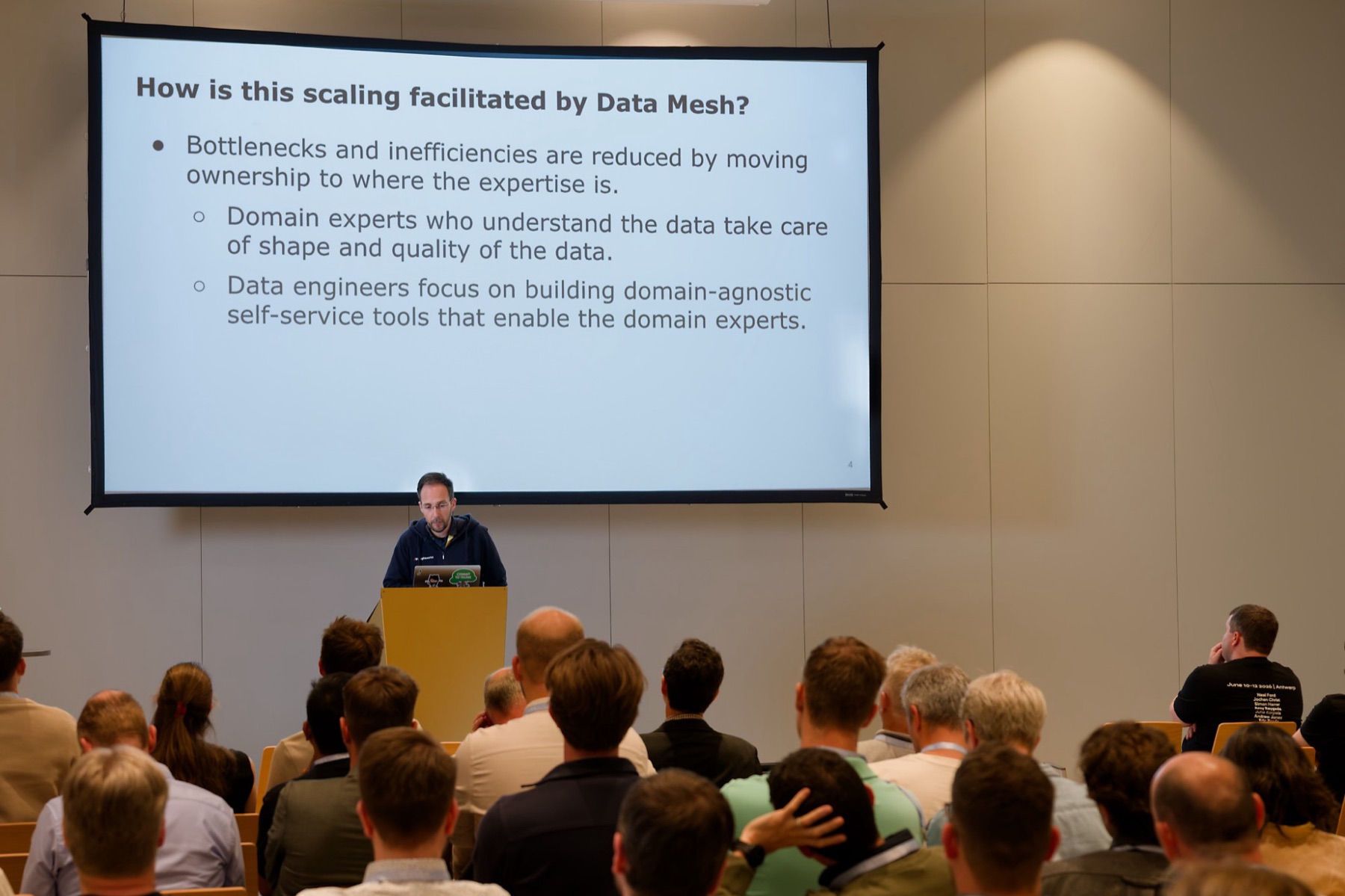
Data Mesh is an enterprise data architecture that shifts the emphasis away from centralised data systems to one where data is owned and shared by different business domains.
When ownership sits with the business domains, rather than with a central data team, organisations can make better use of their data. The people closest to the data understand what it means, where it comes from and when it's wrong.
It’s a socio-technical approach: it changes how teams are organised as much as which technology they use.
A simple example: in a retailer, the e-commerce team owns and publishes online sales data, the logistics team owns delivery data, and the individual store team owns their sales. Any team can find and use the others’ data without asking a central team to build a pipeline first. The result is a mesh of connected data products.
Origins of Data Mesh
Zhamak Dehghani, then at Thoughtworks, first wrote about Data Mesh in 2019 in How to Move Beyond a Monolithic Data Lake to a Distributed Data Mesh. She set out the principles in more detail in 2020 in Data Mesh Principles and Logical Architecture, and went on to popularise the approach with her book Data Mesh: Delivering Data-Driven Value at Scale.
At Data Mesh Live 2025, she explained that the approach formed after direct encounters with the problem. As an outsider – a specialist in distributed software systems – she noticed that the laws of physics that govern distributed systems were not the same laws that governed data.
Since then, Data Mesh has been developed by a wide community of practitioners. Many organisations adopt parts of it and adapt the rest to their own context. Though Zhamak set out the approach, there are many ways that organisations are implementing this ideas in production.
The 4 core pillars of Data Mesh
There are four core pillars of Data Mesh: Domain Ownership, Data as a Product, Self-Serve Data Platform and Federated Computational Governance.
Organisations get value from focusing on any one pillar, but the four are closely related, and most of the value comes when all four are addressed. Each pillar solves a problem the others create: distributing ownership risks new data silos, which treating data as a product counters; asking domain teams to build data products adds work, which the platform reduces; and many independent teams need shared rules, which federated governance provides.
1. Domain ownership
Data ownership should sit with the business domains that produce and understand the data, rather than with a small central team. A domain is an area of the business with its own goals, language and systems.
By giving domains ownership of their data for analytical purposes, teams are responsible not only for using their own data, but for sharing it with the rest of the organisation. Most valuable insights combine data from several domains, so sharing is the point.
2. Data as a product
Teams that own data treat it like an internal product, with the rest of the organisation as its customers. Instead of data being an asset that is hoarded, it’s something designed for others to use, and its success is measured by how useful it is to them.
A good data product is:
- Discoverable – people can find it without asking around.
- Understandable – it comes with documentation and clear meaning.
- Trustworthy – it has a named owner and stated quality expectations.
- Interoperable – it uses shared standards, so it can be combined with other data products.
- Accessible – people can use it with the tools they already work in, from spreadsheets to SQL to machine learning pipelines.
A data product is more than a table or a file. It bundles the data with its metadata, the code that produces it and the policies that govern it.
3. Self-serve data platform
The platform’s job is to take cognitive load off domain teams so that building and sharing data products becomes easy. Most domain teams are made up of generalist software engineers and business experts, not data infrastructure specialists.
In practice, the platform gives teams ready-made building blocks: storage, pipelines, a catalogue to publish and find data products, access control, lineage and monitoring. A platform team builds it once, and every domain uses it, so teams don’t each reinvent their own infrastructure.
4. Federated computational governance
Governance in a Data Mesh is shared, not imposed from a single central function. It has two halves:
- Federated: representatives from the domains and central functions agree a small set of global rules – for security, privacy, compliance and interoperability. Domain teams are then responsible for meeting them in their own data products.
- Computational: wherever possible, those rules are written as code and enforced automatically by the platform, rather than checked manually by a slow, centralised committee.
Governance is not just control: it uses many levers and feedback loops. Catching a problem when data is created is much cheaper than fixing it after everyone has already used it.
At Data Mesh Live 2026, Tom De Wolf ran through a Data Mesh Platform Engineering Maturity Model to help teams on their journey. You can watch the talk on YouTube or see the subsequent write up on Martin Fowler's blog.
Data Mesh vs data warehouse, data lake and data fabric
A data warehouse, data lake or lakehouse is a technology for storing data; Data Mesh is a way of organising who owns data and how it is shared. The two are not mutually exclusive: many Data Mesh implementations run on warehouses, lakes or lakehouses underneath.
| Approach | What it is | Who owns the data | Main focus |
|---|---|---|---|
| Data warehouse | A central store of structured, modelled data for reporting | A central data team | Consistent reporting and BI |
| Data lake / lakehouse | A central store for raw and processed data of any type | A central data or platform team | Scalable storage and processing |
| Data fabric | A technology layer that connects and integrates data across systems, often using metadata and automation | Usually central | Integration and access through technology |
| Data Mesh | An organisational and architectural approach to sharing data across domains | The business domains | Ownership, data products and scaling across teams |
Data fabric tries to solve the integration problem mainly with technology, while Data Mesh tries to solve it mainly by changing ownership and ways of working.
Which companies practise Data Mesh at scale?
Companies including Zalando, Roche, adidas, HSBC and Swisscom have publicly shared their Data Mesh journeys.
| Company | Sector | What they’ve shared |
|---|---|---|
| Roche | Healthcare | A large-scale implementation documented with Thoughtworks; Roche Diagnostics reported 200+ data products in under two years |
| Zalando | Fashion e-commerce | One of the earliest public adopters; moved from a centralised data lake to a distributed Data Mesh |
| adidas | Sportswear | Moved from a central data warehouse and data lake towards Data Mesh as part of its digital transformation |
| HSBC | Banking | Former HSBC data mesh leads have spoken about aligning the mesh to use cases and scaling it |
| Swisscom | Telecoms | Presented at Data Mesh Live 2026 on Data Mesh as the foundation for AI-readiness |
Mirela Navodaru, who leads data architecture implementation at Swisscom, came to Data Mesh Live 2026 to share Swisscom’s Data Mesh journey and how it relates to its push for AI-readiness. Swisscom combines a central hub for data, analytics and AI with business units as spokes: central governance defines the “what and why”, and the domain data teams decide the “how”.
The Data Mesh Learning community has many case studies on their website.
Data Mesh and AI
AI has given Data Mesh a new audience, because AI systems need the same thing Data Mesh was designed to provide: well-described, trustworthy data with a clear owner.
A model or AI agent is only as good as the data it is given. Data products bring the context AI needs – documentation, ownership, quality guarantees and shared definitions that let AI work across domains. As Swisscom puts it, the alternative is “Garbage in, danger out.”

“Data Mesh is the foundation of AI readiness because it produces data with care. We haven’t had to get rid of Data Mesh because of AI; it’s actually what has accelerated our AI readiness.”
In Swisscom’s model, data becomes AI-ready in three steps: first findable and described, then trusted and contracted, then semantically navigable.
Criticisms of Data Mesh and alternatives
The most common criticism of Data Mesh is that it is expensive and hard: it asks for organisational change, not just new tools, and many organisations underestimate that.
Common criticisms
- It needs data skills in every domain. Each domain team needs people who can build and run data products, which only large organisations can usually afford.
- Organisational change is hard. Changing who owns data, how teams are funded and how success is measured takes longer than changing technology.
- It can recreate silos. Without strong shared standards, domains can end up with incompatible data and duplicated effort.
- Vendor water down value. Many vendors label a catalogue or query engine as “Data Mesh”.
- Meta data overlooked. In Ole Olsen-Bagneux's keynote at Data Mesh Live he notes that metadata is overlooked in the writings.
When Data Mesh is not a good fit
Data Mesh is unlikely to be worth it if:
- You are a small company with few business domains, unlikely to scale
- A central data team is meeting demand without becoming a bottleneck
- You lack the engineering maturity (DevOps practices, automation, to build a self-serve platform
- There is no budget or leadership support for organisational change.
Alternatives and partial approaches
- Adopting parts of Data Mesh. Many organisations adopt data products, data contracts or a self-serve platform without calling it a Data Mesh. That is often a sensible first step.
- A well-run central platform. A central data warehouse or lakehouse with a strong data team remains the right answer for many organisations.
- Hub and spoke. A central hub sets standards and runs the platform, while business units own their data. Swisscom’s model is an example of Data Mesh in this form.
Frequently asked questions
Is Data Mesh a technology or a tool?
No. Data Mesh is an approach to organising data ownership and sharing. Tools can support it, but no single product delivers it.
What is a data product?
A data product is a dataset that a domain team publishes for others to use, together with its documentation, owner, quality guarantees, access policies and the code that produces it.
What is the difference between Data Mesh and data fabric?
Data fabric integrates data mainly through a technology layer and is usually centrally run. Data Mesh distributes ownership to business domains and relies on shared standards and a self-serve platform.
Does Data Mesh replace a data lake or data warehouse?
Not necessarily. Data Mesh changes who owns data and how it is shared. Domains often still store their data products in lakes, warehouses or lakehouses.
Is Data Mesh dead?
The hype has faded, but the ideas have not. Data products, data contracts, domain ownership and federated governance are now mainstream practice, and the rise of AI has renewed interest in them.
Meet the community
Data Mesh - and the ideas within the movement - continue to be discussed and presented at data conferences around the world. Data Mesh Live is the only dedicated conference to the approach but places like Helsinki Data Week and Big Data London have talks on the topic.